Unmanned Aerial Vehicles (UAVs), commonly referred to as drones, continue to evolve and redefine modern warfare. With applications ranging from reconnaissance to precision strikes, types of military drones are becoming more advanced, autonomous, and integral to defense strategies worldwide. As technology progresses, the capabilities of UAVs are expanding, offering enhanced intelligence-gathering, combat efficiency, and reduced risk to human soldiers.

UAVs can be used for autonomous flights, this being based on pre-programmed flight plans, or through the help of more complex dynamic automation systems. It is important to appreciate the increasing role of Unmanned Aircraft Systems (UAS) in solving certain conflicts. Also, the execution of high-profile attacks is a crucial task for some modern day military planners.
Modern military drones are also evolving in the way they communicate with operators. New technologies such as fibre-optic controlled drones are being developed to prevent signal jamming and provide ultra-reliable control in electronic warfare environments. If you are eager to learn more about this emerging technology, read our guide on fibre-optic military drones and how they work.
This article will explore a brief history of the use of drones in military applications. The article will examine these military drones based on various categories, such as based on their size, their use, and their complexity.
A brief history of the use of drones in military operations
The name drone was derived originally from the male bee which is characterized by a specific buzzing sound. This sound is quite deep and sometimes annoying. This could have been a similar scenario for the initial drones but the modern day drones have evolved and the main trait that named them (the buzzing) is barely noticeable now. This is why the industry prefers to call them Unmanned Aerial Vehicles now.

The idea of having an unmanned aircraft, was born during WWI when both the US and France were working on developing an automatic airplane. In the end, France was the one who actually managed to put together this sort of contraption. The device was called the Voisin BN3 biplane and was able to fly for about 100km.
The interest to develop unmanned aerial vehicles was further sparked during the WWII when various parties suffered big losses occasioned by the reconnaissance aircraft. A need to develop unmanned aerial vehicles that would do away with the pilot or an observer was necessitated by the bad turn of events. Basically, they wanted to save people’s lives, so that when planes were shot down no one had to perish.
Although this technology was under development for many years, the first time when drones were actually used for observation was in 1973, during the Vietnam War.
In the modern world, UAVs make a lot of sense, especially on the battlefield. They are highly convenient since you don’t have to worry about deploying people behind enemy lines since no one will be on board in case the device gets destroyed.
However, these conveniences do not come without controversy. The ethics behind these aerial vehicles is often a cause of fierce political debate. Much of this debate revolves around the fact that these drones simply make it too easy to carry out military strikes. If military commanders can simply send a drone to do the work of their own troops, they may be blind to the actual consequences of their own warfare. This can lead to a type of attack where the ramifications and collateral damage are not fully known. In some cases, this can even include civilian casualties.
The usage of drones in military operations will certainly continue to be a hot button issue for the foreseeable future. However, for the sake of this article, we will focus on providing an outline of this military technology, as opposed to debating the morals and ethics involved.

It is good to appreciate that many people in the field prefer to use the term Unmanned Aircraft Systems since a UAV is usually part of a system made from:
- one or more drones destined for observation – these are equipped with a series of sensors,
- ground control stations – these are the bases where the drones are controlled. These stations control the drones and receive data from sensors
- The radio connection that is established between the drones and the ground control stations.
The FAA has adopted the UAS – Unmanned Aircraft System acronym, to capture the complex systems which include ground stations and other elements, and not only the actual aerial vehicles.
Classification of Military Drones
Military drones are categorized based on various factors, including size, weight, range, endurance, and operational capabilities. The U.S. Department of Defense classifies UAVs into five groups:
| Group | Maximum Takeoff Weight | Operating Altitude | Speed |
| 1 | < 9 kg | < 365 m | < 185 km/h |
| 2 | 9–25 kg | < 1,065 m | < 463 km/h |
| 3 | 25–600 kg | < 5,500 m | < 463 km/h |
| 4 | > 600 kg | < 5,500 m | any |
| 5 | > 600 kg | < 5,500 m | any |
This classification aids in determining the deployment and operational use of drones in various military scenarios.
Types of Military Drones
1. Micro and Nano Drones
These are the smallest class of drones, often weighing less than 250 grams. Designed for short-range reconnaissance and surveillance, they are ideal for operations in confined or urban environments. Their compact size allows for discreet deployment, making them valuable for intelligence gathering on the battlefield.

Example: Black Hornet Nano – A palm-sized drone used by various military forces for surveillance and reconnaissance, providing real-time video feeds in challenging environments.
2. Mini Drones
Weighing between 2 and 25 kilograms, mini drones are used for short-range surveillance and reconnaissance missions. They offer longer endurance and greater payload capacity compared to micro drones, making them suitable for tactical operations.
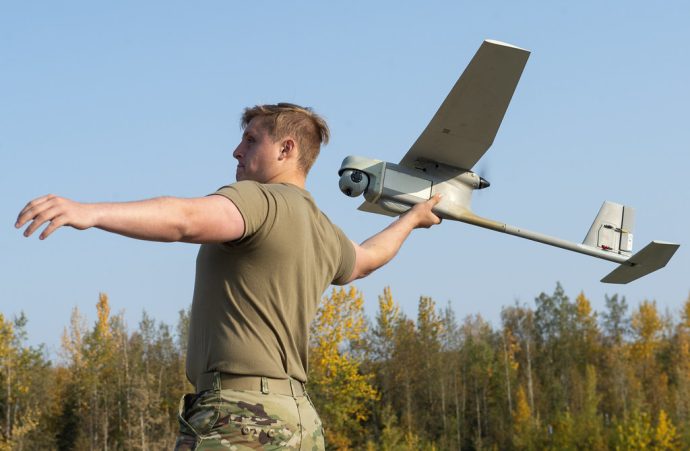
Example: RQ-11 Raven – A lightweight, hand-launched UAV used by the U.S. military for surveillance and target tracking, with a range of up to 10 kilometers.
If you want further information about the best consumer drones that are available in micro models, by reading our article about micro drones.
3. Tactical Drones
Tactical drones are medium-sized UAVs designed for various missions, including surveillance, target acquisition, and electronic warfare. They operate at altitudes up to 5,500 meters and can carry multiple payloads, such as sensors and communication equipment.
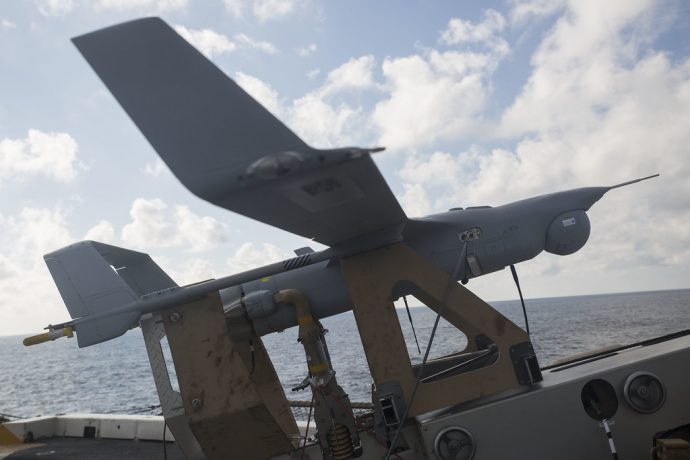
Example: RQ-21 Blackjack – A runway-independent drone used by the U.S. Navy and Marine Corps for maritime and land-based reconnaissance missions.
4. MALE (Medium Altitude Long Endurance) Drones
MALE drones operate at altitudes up to 9,000 meters with extended endurance capabilities. They are primarily used for long-duration surveillance, reconnaissance, and intelligence missions. Notable examples include the MQ-1 Predator and the Turkish Bayraktar TB2.
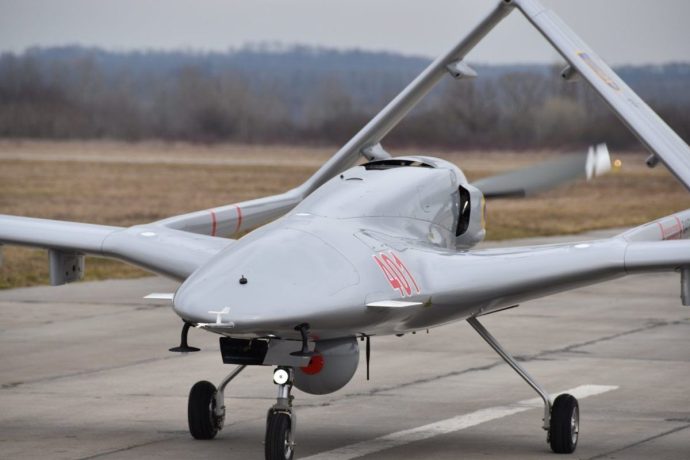
Example: Bayraktar TB2 – A highly effective Turkish drone used in multiple conflicts worldwide, renowned for its precision strikes and endurance.
5. HALE (High Altitude Long Endurance) Drones
HALE drones are designed for prolonged operations at altitudes above 9,000 meters. They provide strategic intelligence, surveillance, and reconnaissance capabilities over vast areas. The RQ-4 Global Hawk is a prominent example of a HALE drone.
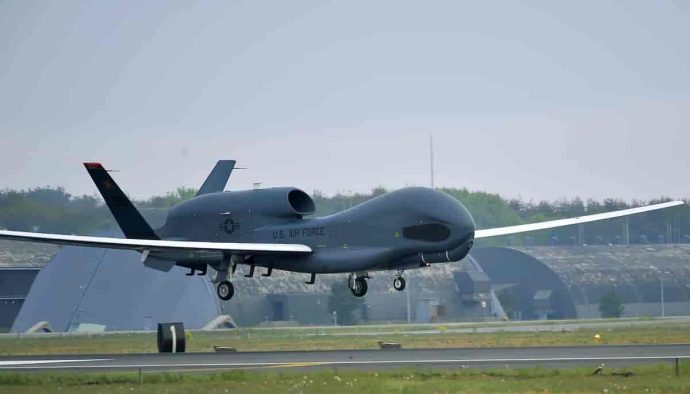
Example: RQ-4 Global Hawk – A high-altitude, long-endurance UAV designed for extensive ISR missions, with capabilities for over 32 hours of continuous flight.
6. Unmanned Combat Aerial Vehicles (UCAVs)
UCAVs are armed drones capable of conducting precision strikes against ground targets. They are equipped with advanced targeting systems and can carry various munitions. The MQ-9 Reaper and the Turkish Bayraktar Akıncı are examples of UCAVs.
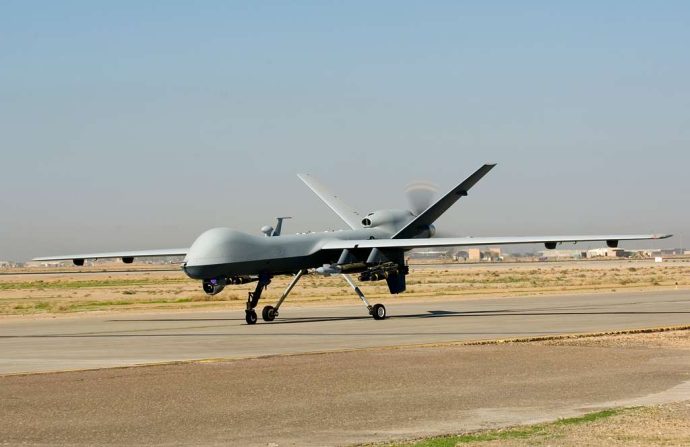
Example: MQ-9 Reaper – A combat UAV used by the U.S. Air Force, equipped with Hellfire missiles and laser-guided bombs for high-precision strikes.
Recent Technological Advancements
The field of military drones is continually evolving, with several notable advancements:
AI-Powered Military Drones
Artificial intelligence is becoming a key component in modern UAV systems. AI-powered drones can assist with target recognition, autonomous navigation, and real-time decision-making, reducing the workload on human operators and improving mission efficiency.
While most current systems are still human-controlled with AI assistance, the level of autonomy is steadily increasing. These technologies are already being integrated into various drone types, including reconnaissance UAVs and loitering munition systems.
👉 Learn more in our detailed guide on AI military drones and how autonomous UAVs work.
Swarm Technology
Swarm technology involves deploying multiple drones that operate collaboratively to achieve mission objectives. This approach enhances mission success rates through redundancy and the ability to overwhelm adversary defenses. Swarm drones can be used for surveillance, electronic warfare, and coordinated attacks.
Counter-Drone Systems
As drones become more prevalent, counter-drone technologies have been developed to detect, track, and neutralize hostile UAVs. These systems employ methods such as signal jamming, laser weapons, and kinetic interceptors to mitigate drone threats.
Fibre-Optic Controlled Drones
One of the newest developments in drone warfare is the use of fibre-optic communication cables instead of traditional radio signals. These drones remain physically connected to the operator through a thin fibre-optic line, allowing them to transmit control signals and high-resolution video without being affected by electronic warfare or signal jamming.
Because the connection is physical rather than wireless, fibre-optic drones can operate effectively in environments where radio communications are heavily disrupted.
👉 Learn more in our guide on Fibre-Optic Military Drones.
Loitering Munition Drones
Another rapidly growing innovation is the use of loitering munition drones, sometimes referred to as kamikaze drones. These systems combine the surveillance capabilities of UAVs with the destructive power of guided missiles.
Instead of returning after a mission, loitering munition drones can loiter over a target area before diving into the target with an explosive payload. Their relatively low cost and precision targeting capabilities have made them an increasingly important tool in modern warfare.
👉 Read more in our article about Loitering Munition (Kamikaze) Drones.
Advanced Propulsion Systems
Innovations in propulsion systems, including hybrid and solar-powered engines, have extended the range and endurance of military drones. These advancements allow for longer missions and reduced logistical support requirements.
In conclusion
Unmanned Aerial Vehicles continue to be applied in various military operations. They are a growing field due to the high amount of convenience, and the ability to reduce casualties so drastically. Because of this, drones are enabling the execution of high-profile missions across the world.
Their origin can be traced back to WWI, when the United States and France had the idea of developing an aircraft that had no human pilot on board, to be used in warfare. And then they were first used during the Vietnam War. From there, the applications and technological innovations continued to expand, as you can see by the vast array of drones that were outlined in this article.

Military drones have transitioned from supplementary tools to essential components of modern warfare. Their increasing autonomy, expanded operational capabilities, and adaptability in various combat scenarios make them indispensable assets for defense forces worldwide. The integration of artificial intelligence, swarm capabilities, and counter-drone technologies will continue shaping their future roles.
While ethical and political discussions about the deployment of UAVs persist, there is no doubt that these systems have revolutionized military strategies. Future developments may include completely autonomous drones, enhanced stealth capabilities, and AI-driven decision-making, further cementing their role in 21st-century warfare. The rapid growth of UAV technology ensures that military forces will continue investing in and refining these advanced systems to maintain strategic superiority on the battlefield.